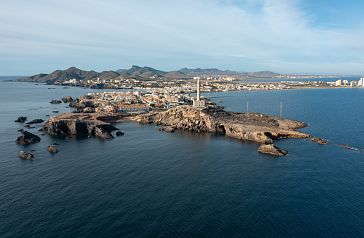
Salinas and Arenales of San Pedro del Pinatar
San Pedro del Pinatar is a town in the Region of Murcia and one of the most well-rounded destinations on the Costa Cálida. It is also located very close to our Hotel Servigroup Galúa and the Hotel Servigroup la Zenia. This charming town owes its distinctive name to none other than the vast pine forest that once stood there—so extensive that, back in the 17th century, wild boar were hunted there in the winter.
If you are wondering what makes San Pedro del Pinatar so special and why it is well worth a visit, the answer lies in a true haven for nature lovers: the Salinas y Arenales de San Pedro del Pinatar Regional Park.
What are the San Pedro del Pinatar salt flats and why are they pink?
The Salinas y Arenales de San Pedro del Pinatar are a protected natural area and wetland of great ecological importance, covering 856 hectares. This unique landscape combines sand dunes, unspoilt beaches, a rich diversity of migratory birds and working salt flats that are still in operation today.
The striking pink colour of the lagoons is not actually caused by the salt itself, but by a fascinating biological phenomenon. These hypersaline waters are home to extremophile microorganisms such as the microalga Dunaliella salina and various halophilic bacteria. They produce reddish pigments and carotenoids to protect themselves from intense solar radiation.
It is an ideal destination for family tourism, hiking and nature photography, particularly at sunset, when the sunlight brings out the spectacular colours of the landscape.
Wildlife and plant life in the San Pedro del Pinatar salt flats
The park is an important nature reserve for numerous species of aquatic and migratory birds. Without a doubt, the stars of this wetland are the flamingos.
Their distinctive colour is directly linked to the salt-flat ecosystem. Flamingos consume large quantities of brine shrimp (Artemia), absorbing the pigments they contain and gradually developing their characteristic pink plumage.
Hiking Through the San Pedro Salt Flats
The park features three different marked trails that let you discover all the wonders this area has to offer. These are low-to-moderate-difficulty trails equipped with informational signs so you can enjoy a stroll through the salt flats and have a special day.
The 3 Hiking Trails:
Senda de las Encañizadas (PR-MU 65): This is the longest and most comprehensive route. It’s a circular trail of about 12 km (about 3 to 4 hours on foot), ideal for observing traditional fishing methods and the largest concentration of birds.
Camino de Quintín: A comfortable, linear route of about 7.9 km that takes you directly through the salt flats.
Laguna del Coterillo Trail: This is a short and very accessible 6.6-km loop (about 1 hour and 40 minutes), excellent for walking with children and reaching Torre Derribada Beach.
Mud Baths at Villananitos Beach
The beaches of San Pedro del Pinatar are among the area's greatest attractions, thanks to their privileged location between the Mar Menor and the Mediterranean Sea. With calm waters, fine sand and a wide range of facilities, they are an excellent choice both for families with children and for visitors looking to relax and enjoy some self-care.
San Pedro del Pinatar is also home to what is considered Europe's largest open-air iodotherapy area, making it particularly popular with visitors interested in wellness and the traditional properties associated with its mineral-rich mud.
Three beaches stand out in particular.
The first is Villananitos Beach, famous for its shallow waters and as the main location for the area's popular mud baths. This free experience attracts many visitors because of the traditionally claimed benefits of the mineral-rich mud for the skin and joints.
The second is La Puntica Beach, located next to the marina. It is particularly popular for its lively local atmosphere and its proximity to numerous bars and restaurants.
Finally, La Mota Beach is the perfect choice for anyone looking for a quieter and more natural setting, as it forms part of the surroundings of the Salinas y Arenales de San Pedro del Pinatar Regional Park.
All three beaches feature seafront promenades, calm bathing areas and good connections, making it easy to explore the coastline either on foot or by bicycle.
Practical information for visitors
Best time of year and time of day to visit
The summer months, from June to August, are the best time to see the lagoons at their most intensely pink. High temperatures and increased evaporation raise the salt concentration in the water, encouraging bacteria and microalgae to produce more of their characteristic pink pigments.
For flamingo watching, late July is particularly recommended, as historically this is when some of the largest concentrations of flamingos can be seen in the area.
How to get there and where to park
The park is quick and easy to reach by car. If you are travelling from Murcia, the journey takes around 40 minutes via the RM-19. From Alicante, it takes approximately one hour via the AP-7.
For free parking, one option is the area by the Las Salinas Visitor Centre, located next to the roundabout at the entrance to the park. Alternatively, you can use the Las Salinas car park, which is very close to the start of the pedestrian boardwalks.
Tips and recommended equipment
Swimming in the pink lagoons is prohibited: These lagoons form part of an active and protected salt-production area. Bathing is only permitted in the designated mud-bathing area in Lo Pagán.
Stay on authorised paths: Visitors must not leave the wooden boardwalks or walk across the dunes, as this can damage native vegetation and disturb birds' nesting areas.
Sun protection: There is very little shade in the area, so a hat or cap, sunglasses and high-factor sun cream are essential.
Mosquito repellent: As this is a coastal wetland, insects can be particularly abundant, especially towards the end of the afternoon.
Suitable footwear: Wear comfortable, closed sports shoes for walking along the dirt paths and wooden boardwalks.
Stay hydrated: There are no shops or drinking fountains along the nature trails, so make sure you bring enough water for the entire route.
Where to Stay Near the Salinas de San Pedro
If you are looking for accommodation in San Pedro del Pinatar, just 13 km away you can stay at our Hotel La Zenia. It is located between two beaches and has spectacular views of the sea, perfect to combine healthy leisure and rest. No doubt its proximity makes it an ideal hotel if you want to visit San Pedro del Pinatar, the natural park, and Salinas y Arenales.
Another option to take into account, even if a little further away... is the Hotel Galúa in La Manga, located between two beaches of first-class quality. A hotel especially recommended for families where you can stay and make a trip to the salt flats and sandy areas of San Pedro del Pinatar as it is located less than 50 km from the regional park "Salinas de San Pedro".
The great variety of fauna and flora that inhabits this regional park, in addition to the diversity of activities offered, converts "the salt pans and arenales areas of San Pedro del Pinatar" into a point of interest that you should not miss.
Do you fancy taking this trip to San Pedro del Pinatar? We are convinced that you will not be disappointed.